

Pure&Porous® Surface:
Why the Surface Structure
of Smart Implants
Is More Important Than It Seems
Contents
- How It All Happened: the Path from Smooth Titanium to SLA and RBM
- The Biology of Osseointegration: Why Surface Topology Matters
- Why Pure& Porous® Differs from SLA and RBM
- Surface Morphology: A Look Under the Microscope
- Clinical Aspects
- Conclusion
In this article, we explain how the Pure& Porous® modified surface differs from other treatment types. First, let’s review why roughness and irregularities are created on the surface of titanium implants. Osseointegration is a key indicator of implant success. The implant’s surface topography directly impacts the rate of osseointegration and the risk of implant failure. Dr. Brånemark’s original implants featured a smooth, machined surface. While they integrated successfully with the bone, the process was very slow. However, in the late 1980s, experiments with sandblasting began. Even then, researchers realized that roughness and irregularities help bone cells adhere to the surface. This significantly increases both the speed and quality of osseointegration.
How It All Happened: The Path from Smooth Titanium to SLA and RBM
The first modern implants appeared in the late 1970s and featured a smooth surface. As mentioned, today. However, osseointegration took months, and the failure rate was significantly higher than it is today.
By the late 1980s and early 1990s, methods for modifying titanium surfaces emerged:
- SLA (Sandblasted, Large grit, Acid-etched): This was the first successful texturing technology and is still used today with modifications. It involves sandblasting with a coarse aluminum oxide abrasive, followed by acid etching to dissolve abrasive fragments and further increase roughness. This results in the formation of cavities, depressions, and peaks on the surface. The increased contact area significantly accelerates osseointegration. However, removing 100% of the aluminum oxide particles is not always possible, and this material is not biocompatible. Furthermore, etching with aggressive acids is a complex and expensive process.
- RBM (Resorbable Blast Media): This involves sandblasting with biodegradable calcium phosphate particles. Unlike SLA, it leaves no foreign particles on the surface, reducing the risk of inflammation.
Each technology had its pros and cons. SLA produced pronounced roughness but could leave aluminum oxide residue. RBM provided a clean finish but a less aggressive texture. Other surface treatment technologies exist, but they are not widely used and are not relevant to this comparison.
The Biology of Osseointegration: Why Surface Topology Matters
Almost immediately after the implant is placed, a complex biological process begins:
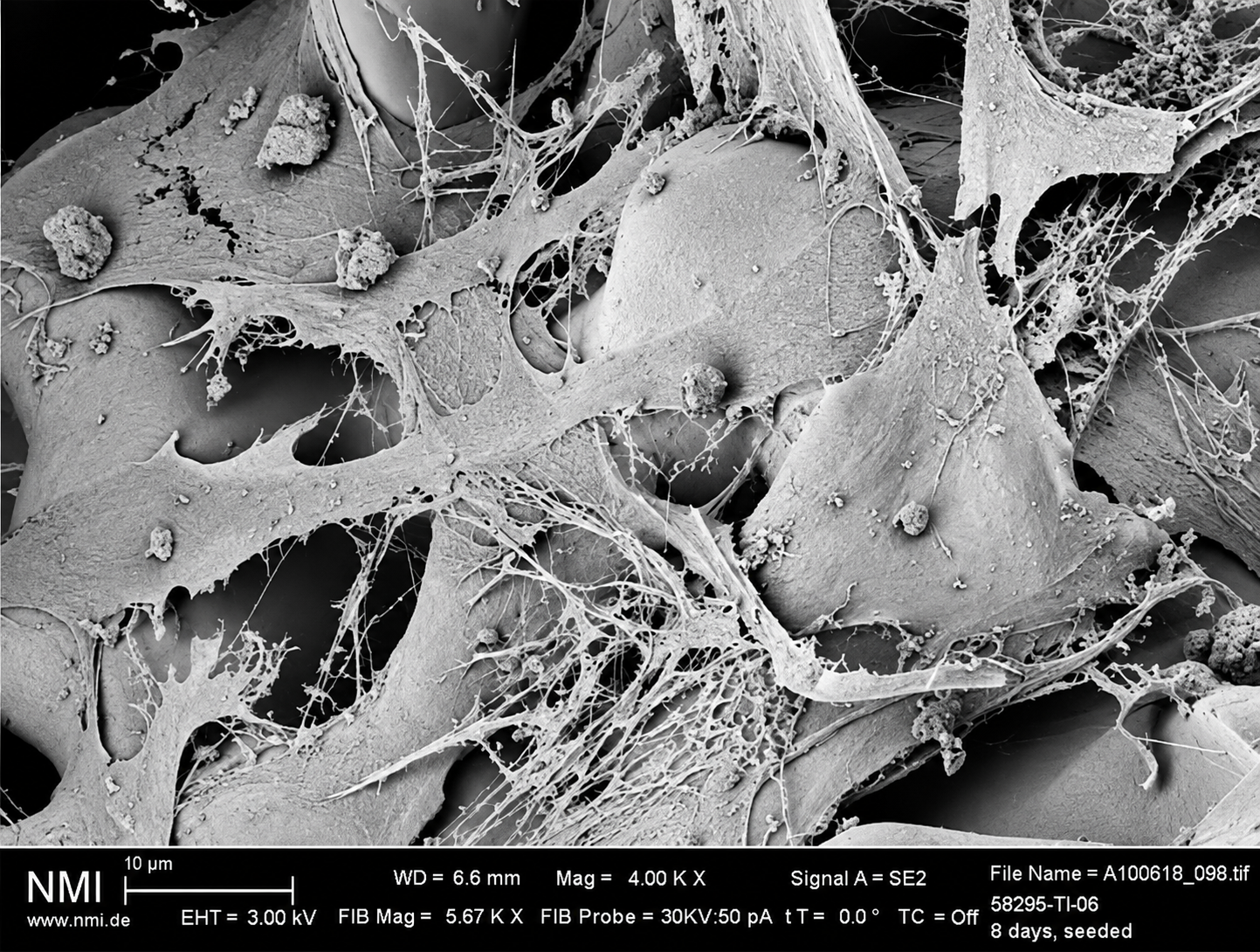
- Osteoblasts attach to the surface. The image below depicts the titanium surface with osteoblasts attached on the 8th day after placing the titanium in a culture medium.
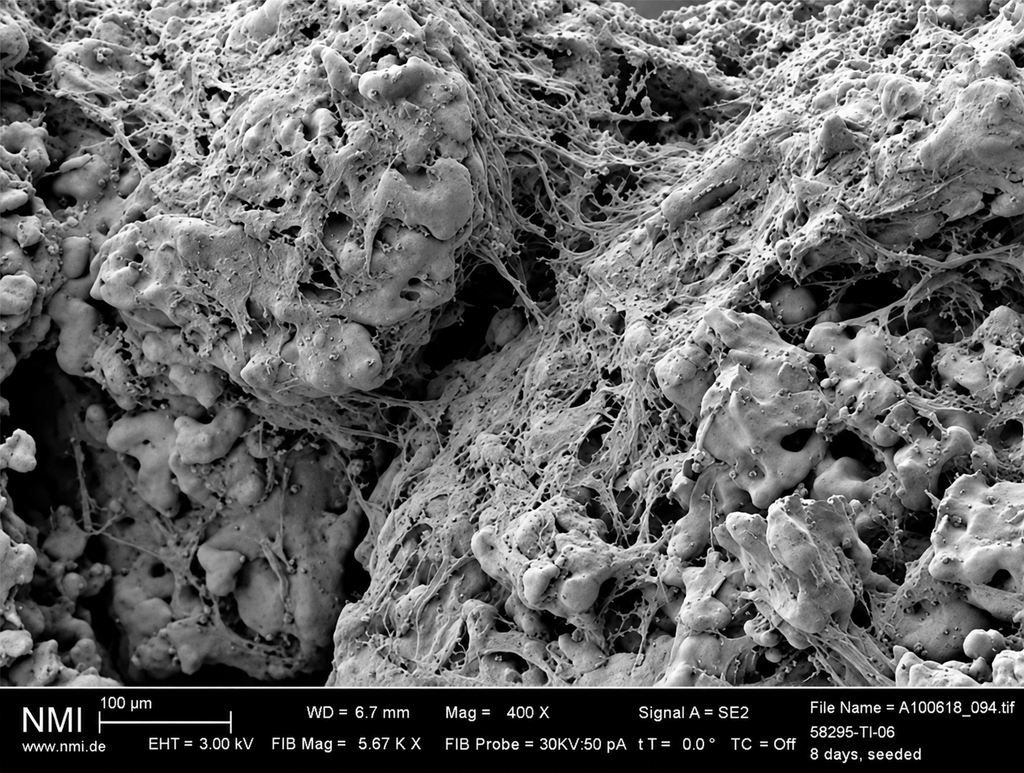
A sample seeded with osteoblasts. The titanium surface is exposed in places. Osteoblasts are attached to the titanium surface. /Natural and Medical Sciences Institute at the University of Tübingen (Germany)/ 2010
- The bone matrix is formed.
- Mineralization and the formation of strong bone-to-implant contact occur.
A key role in the initial stages is played by microtopography. Roughness, surface charge (ionization), and hydrophilicity determine how quickly cells attach and begin to function. The more optimal the structure, the faster the osseointegration and the higher the success rate.
Why Pure& Porous® Differs from SLA and RBM
The engineers who developed Pure& Porous® technology aimed to combine the strengths of SLA and RBM.
- First, the surface is treated with biodegradable calcium phosphate particles (as in RBM). This ensures purity, with no aluminum oxide residues. However, these relatively soft particles cannot create the required deep structure alone, given the hardness of titanium.
- Then, after treatment with calcium phosphate, acid etching is carried out (as in SLA), which enhances micro- and macro-roughness.
As a result, the surface is simultaneously clean and textured to accelerate osseointegration and reduce the risk of complications.
Surface Morphology: A Look Under the Microscope
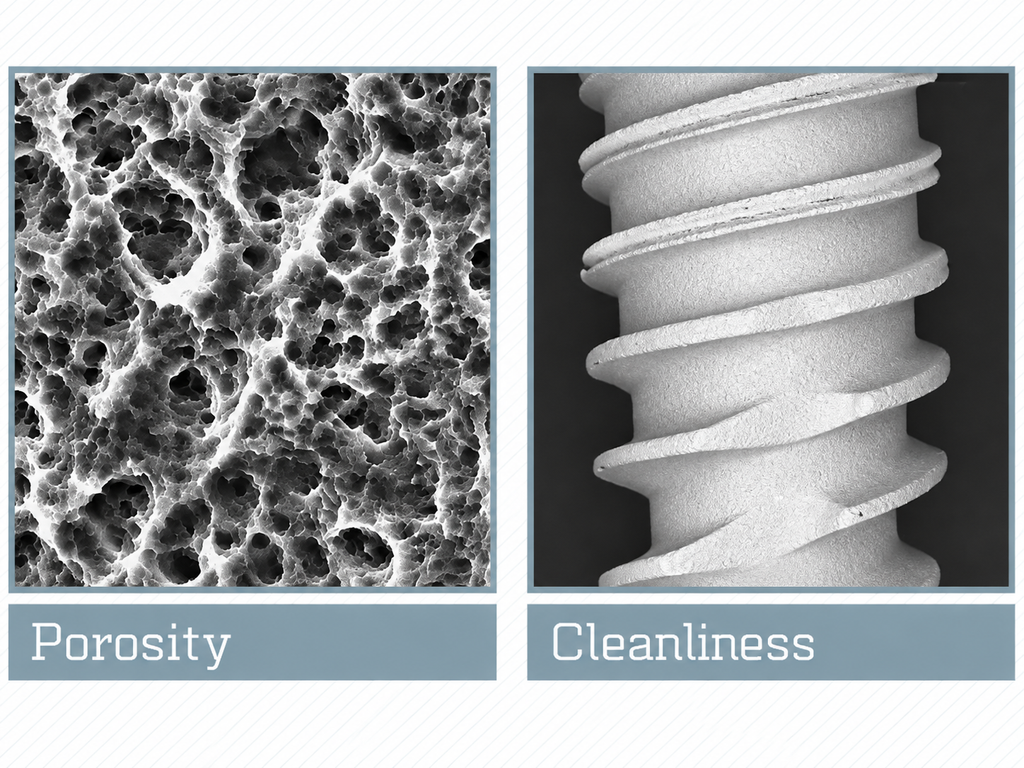
When examining the Pure& Porous® surface under an electron microscope, one can observe:
- Micropores: The result of acid etching.
- Uniform roughness: Achieved via CaP sandblasting.
- Absence of foreign particles: Calcium phosphate dissolves completely.
This structure creates optimal conditions for osteoblast attachment and bone contact formation.
Equally interesting are SEM images at 50x magnification in backscattered electron (BSE) mode, which highlight any non-metallic inclusions on the surface in black. The more black dots present, the more contaminated the surface.
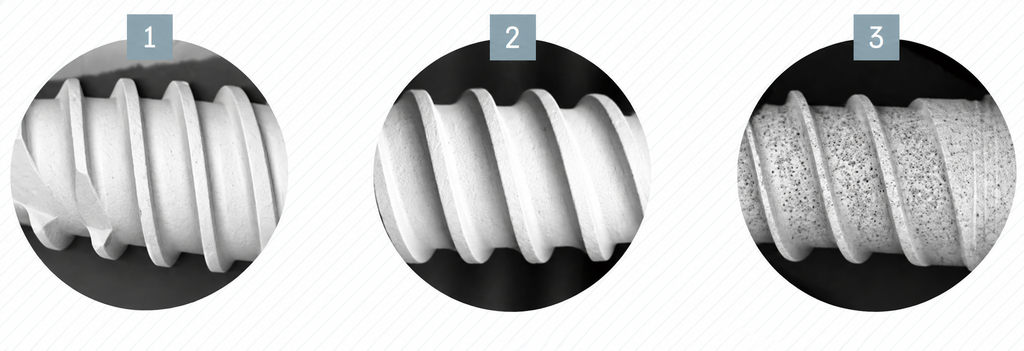
SEM images: 1. Smart Implants Pure& Porous® – no black spots at all. 2. The surface of the closest competitor on the market – almost clean. 3. A common implant on the market – many dark spots.
The cleanliness of items (1) and (2) compared to the contamination of item (3) is visually obvious.
Another series of images shows the surface structure obtained via different methods.
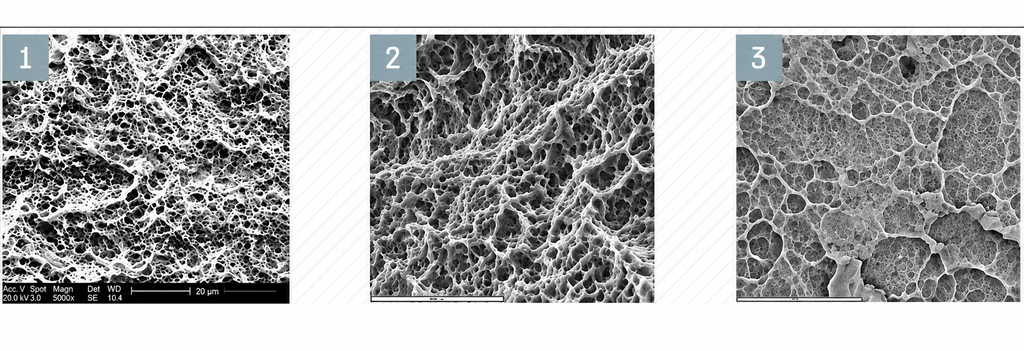
SEM SE surface images at 2000x magnification: 1. Smart Implants Pure& Porous® (batch D02021, April 2018) – good relief. 2. Surface created using SLA technology – excellent relief. 3. Surface created using RBM technology – mild irregularities, potentially leading to delayed osseointegration.
As seen in the images, the surface of implants created using Pure& Porous® technology is comparable to the surface of SLA implants and significantly superior to “pure” RBM.
Clinical Aspects
Practicing dentists note several observations:
- Osseointegration rate: Averages 8–10 weeks, which is comparable to SLA, but the surface is cleaner.
- Aesthetic zone: Due to predictable osseointegration and marginal bone stability, this technology is potentially useful in the anterior maxilla. Stable bone indirectly supports the gingival contour, which is crucial for aesthetics, although the roughened surface itself is designed for subcrestal placement and does not interact with soft tissues.
- Long-term results: While there is less longitudinal data than for SLA, initial studies show implant survival rates of 95% and higher.
Comparison of Technologies
| Technology | Advantages | Flaws |
|---|---|---|
| SLA | High roughness, accelerated osseointegration | Possible residues of Al₂O₃ |
| RBM | Clean surface, biocompatibility | Less pronounced texture |
| Pure& Porous® | A combination of cleanliness and roughness | Newer technology, fewer long-term studies |
Conclusion
The implant surface is more than just a technical specification; it is a key factor determining the success of osseointegration. Pure& Porous® technology demonstrates how Smart Implants strives to combine best practices and minimize risks. For practicing dentists, this is not a reason to change established protocols, but a good example of the future direction of implantology.